
Summit, carefully
FPRI commentary on last week's US-Japan leader summit

Friends, after my last post, I had been originally planning to write (more) about the Kumamoto semiconductor ecosystem. However, this post, and the next, will be on recent publications.
On March 23, in a joint article with Shihoko Goto of Foreign Policy Research Institute (FPRI) and Mirna Galic, I provided commentary on collaboration and local investment aspects of the US-Japan summit held in Washington DC on March 19.
For more, please find the article in its entirety at FPRI’s website.
What follows below is additional context on the lead-up to the summit, and what was said (and also not said). Behind the fold: some additional analyst’s notebook material.
Last Thursday and Friday Prime Minister of Japan Takaichi Sanae visited Washington DC for a two-day visit and summit with President Trump. The summit came all of five weeks after her resounding election win in a snap election on February 8, which gave the Liberal Democrat Party a supermajority in the lower house of Japan’s Diet.
FPRI commentary on PM Takaichi’s election win, again in collaboration with Mirna Galic and Shihoko Goto, is below. In my contribution, I focused mainly collaboration opportunities in semiconductors, innovation and entrepreneurship, and defense.
On to the March 19 summit. First, some background:
On February 18, Japan and the US announced the first batch of projects in the Japan-US Strategic Investment Initiative.
The second batch of projects was indeed announced March 19-20 summit, a mere month later, and coming less than six weeks after PM Takaichi’s election win.
Why so soon? The timing of PM Takaichi’s visit was originally driven by another event - Trump’s planned trip to China for a summit with President Xi Jinping, which had been scheduled to take place from March 31 to April 2. That summit has been postponed.
Thus, while still in part a trade-focused mission, the significance of PM Takaichi’s visit on March 19-20 was transformed by events: she became the first G-7 leader to visit Washington DC since the United States and Israel commenced operations against Iran on February 28, leading to, among other things, an effective closure of the Straits of Hormuz.
Decades since the oil shortages of the 1970s, Japan’s economy is less dependent than it was on crude oil, but it remains heavily dependent on imported energy, and that is mainly fossil fuels. While LNG suppliers are diverse and include Australia, Malaysia and the United States, among others, Japan’s imports of crude oil, as a rule, traverse the Straits of Hormuz.
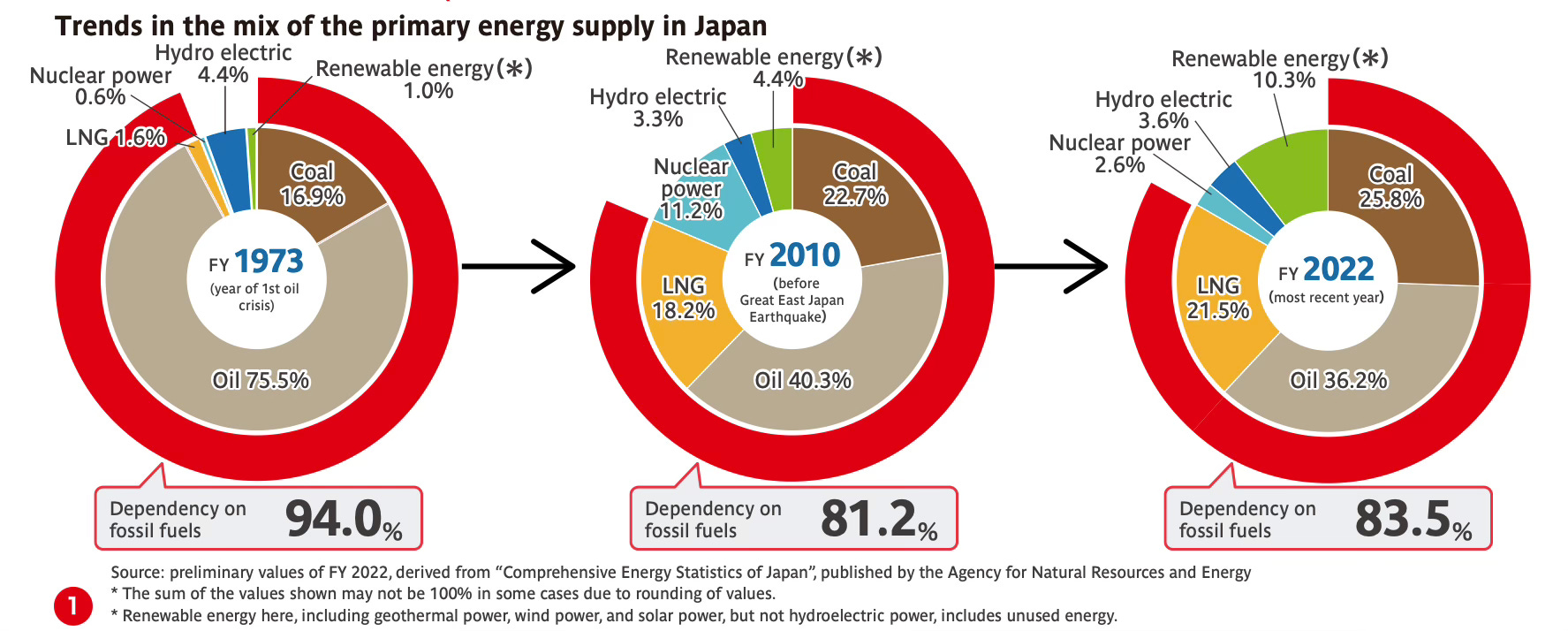
On Straits of Hormuz traffic and Japan’s dependency: CSIS had a great data viz-supported article on the Straits of Hormuz on March 6 and a subsequent article on March 20.
It was thus noteworthy and also not surprising that PM Takaichi (former economic security minister) used the summit as an opportunity to propose that Japan procure crude oil (PM Takaichi’s remarks on that to Japanese media here) directly from the US (MoFA’s statement on that here), and have that work be a joint Japan-US collaboration (and one that counts towards the Strategic Investment Initiative, perhaps?) and one which would help diversify Japan’s supply.
A question I had heading into the summit, given usage levels of US munitions, and the redeployment of various US assets from Asia to the Middle East, including from Japan - what might Japan propose? How might Japan turn potential crisis into opportunity? Offer more munitions production capacity? From the FPRI article:
For instance, given usage levels of US munitions supplies in the Middle East, could Japan provide additional manufacturing capacity? As oil and energy prices rise, would events in the Middle East lead to any new energy-related collaborations? And indeed, during the summit, Prime Minister Takaichi proposed stockpiling in Japan oil directly procured from the United States as an avenue of joint US-Japan collaboration, and one that would diversify Japan’s crude oil supply. Further, the post-summit statement from the White House highlighted that Japan would rapidly quadruple production of SM-3 Block IIA missiles in Japan, in addition to “scoping Japan’s role” in increased advanced medium-range air-to-air missile production capacity.
Linking here to the White House statement issued March 19.
On the trade and investment topic, three new projects were indeed introduced. From the FPRI article:
Three new projects were announced at the summit meeting, bringing the total number of projects under the Japan-US Strategic Investment Initiative to six. The latest additions were the construction of small module reactors (SMRs) by GE Vernova Hitachi in Tennessee and Alabama, with an investment of up to $40 billion, and the construction of natural gas generation facilities in Pennsylvania and Texas, with a combined investment of up to $33 billion. The Tennessee announcement likely refers to plans to construct the first BWRX-300 small modular reactor at the Tennessee Valley Authority’s (TVA’s) Clinch River utility site. TVA also operates nuclear power generating facilities in Browns Ferry, Alabama. The BWRX-300 nuclear SMR by GE Vernova and Hitachi is a boiling water reactor that can produce up to 300 megawatts. GE Vernova Hitachi states that the first power plant using the BWRX-300 SMR will come online in Ontario, Canada, in 2030. All these projects are described as being in the “pre–final decision” stage.
The above is far more detail than was in the White House statements or various media. I dug into releases from GE Vernova Hitachi, US Dept of Energy and the NRC, among others.
On March 14, in the lead-up to the summit, the US-Japan Critical Minerals Investment Ministerial was held in Tokyo. This led to a Memorandum of Cooperation Regarding Deep-Sea Mineral Resource Development between Japan’s METI and the US Dept of Commerce, issued timed with the summit on March 19. From the FPRI article:
This built on a critical minerals framework between Japan and the United States announced in October 2025 and also reflects Japan’s investment in a deep-sea rare earth extraction project conducted by the Japan Agency for Marine-Earth Science and Technology in February 2026 near Minamitorishima, a Pacific atoll in the Ogasawara Islands and Japan’s easternmost territory. Specific projects in the United States highlighted by the critical minerals MOC include one in Arizona and two in Indiana: the Copper World copper mine project in Arizona, which has 30 percent ownership by Mitsubishi Corporation; a secondary smelter with Exurban in Indiana, with investment from Mitsubishi Materials and Rio Tinto; and a collaboration between Mitsubishi Materials and ReElement Technologies Corporation, LLC, a subsidiary of American Resources Corporation in Indiana. The MOC also highlighted a collaboration between Alcoa and Japan Australia Gallium Associates, a joint venture between Japan’s Sojitz and the Japan Organization for Metals and Energy Security in Australia.
I’ll conclude as I did in the article:
With the possible exception of natural gas projects, where US data center builders (at least, those with access to turbines, which themselves can be in short supply) have displayed surprising speed in getting projects online, all these projects involve relatively long-term investment and development. In some cases, the announced projects acknowledge existing collaborations, such as GE Vernova Hitachi with the TVA, or Mitsubishi Materials and Exurban. As a whole, they highlight clear synergy in the fields of energy and critical minerals. It will take time for these projects to impact supply chains and local economies.
Looking forward to your comments.
In other news, I have a book on regional economic innovation and universities coming out in Japan….today. More on that in my next post! This builds on a series of articles published last summer with two members of Keio University faculty. Here’s a post on that series of articles.
Thanks for reading!
Jon
Behind the fold: some extras from my notebook. 📓
