
Assessing Japan's Economic Security Promotion Act, part 1: defining economic security
Also, school in July?; JETRO J-StarX founders; Kumamoto earthquake and more

Friends, was that a campus welcome happening at Berkeley Haas in July? Indeed it was. It was a pleasure to join the WE Launch event to welcome the incoming Weekend and Evening MBA students….and then the RE Launch event to welcome back second year EWMBA students.


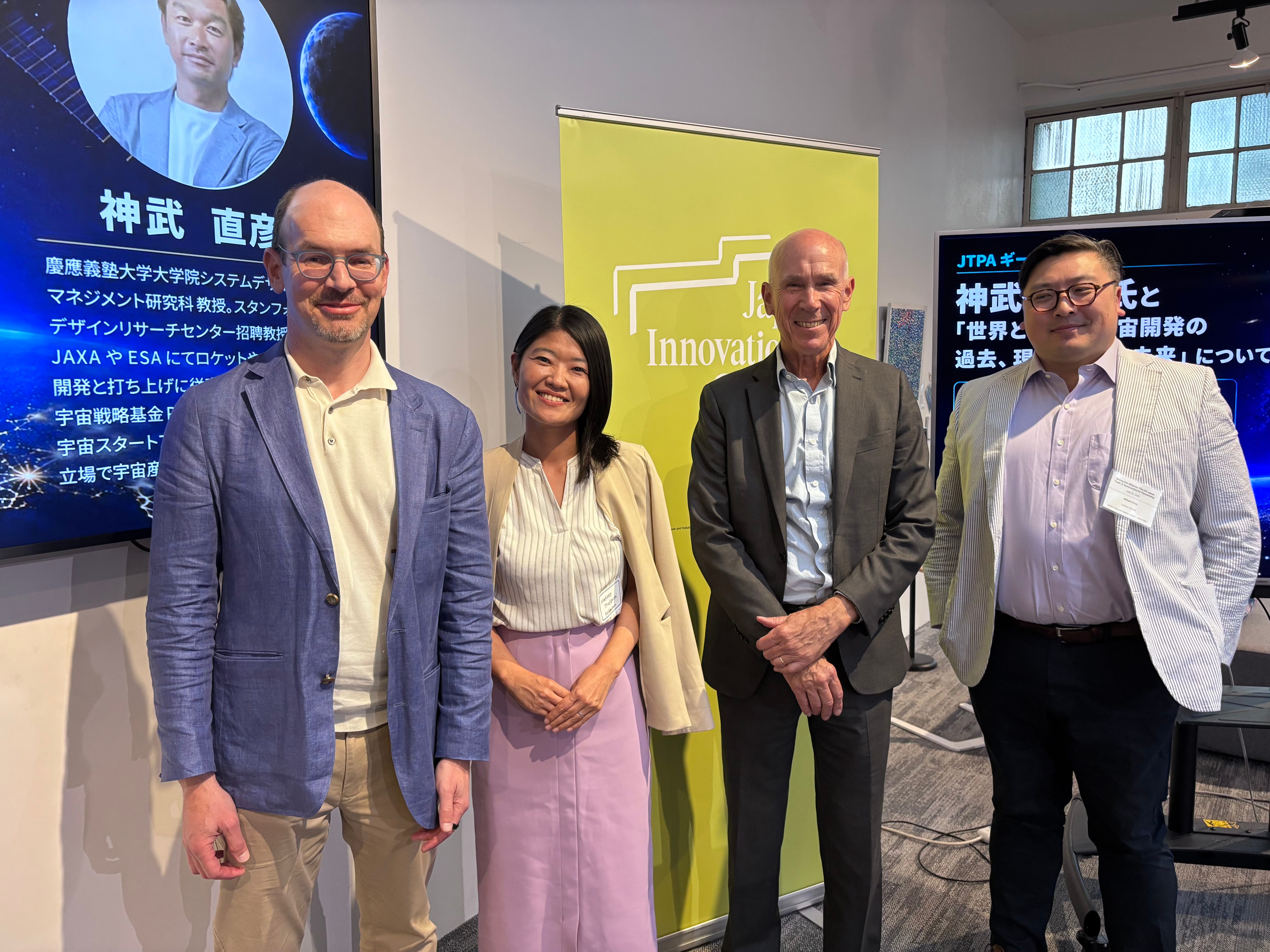
Many thanks to the trade and semiconductor nerds mavens who joined a Friday evening discussion of the US-Japan trade and semiconductor relationship in Palo Alto on July 24. Thanks to our host, the Japan Innovation Campus, and to our co-sponsors, JETRO and the Institute for Business Innovation at Berkeley Haas. Thanks also to Amb. Larry Greenwood for moderating.
And was that a group of student founders from Japan that arrived on campus this weekend via the JETRO J-StarX program? 🛬 Looking forward to speed-running them through a 3-week immersive on campus. More to come on that topic soon.
Kumamoto earthquake news
We are in touch with various folks (JETRO Kumamoto, Kumamoto University) in Kumamoto following a serious earthquake there on July 28. Per NHK, temperatures of 38C and water shortages are impacting recovery efforts. Nikkei has had consistent coverage of the industry impact, including damage to an Aisin plant that could impact automotive supply chains.
The TSMC JASM fab (TSMC Fab 23 P1) there is back in operation, and construction on the second fab has resumed.
Nikkei also posted a table summarizing previous major earthquakes and their impact on the semiconductor industry, going back to 1995, which I’ve translated below.
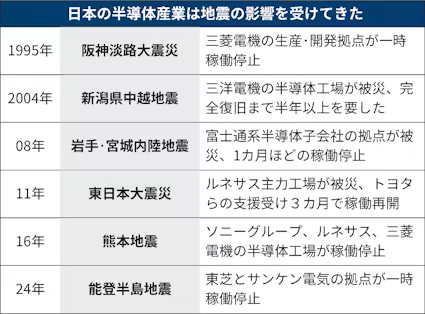
1995: Great Hanshin Earthquake: Mitsubishi Electric fab and development centers temporary shut down
2004: Niigata Chuetsu earthquake - Sanyo Electric plant damaged and out of operation for six months
2008: Iwate / Miyate Nairiku Earthquake: A Fujitsu semiconductor subsidiary plant damaged and was out of operation for one month.
2011: Great Tohoku Earthquake: this was the triple disaster. Renesas’ plant was damaged, and with help from Toyota and others restarted after 3 months.
2016: Kumamoto. Sony Semiconductor, Renesas, Mitsubishi Electric plants were all temporarily idled.
2024: Noto Earthquake: Toshiba and Sanken Electric plants were temporarily idled.
Kumamoto is a castle town. When I visited Kumamoto in 2025, renovations of Kumamoto Castle from the 2016 quake had just been completed.
While the earthquake was serious, other local logic fabs (Mitsubishi, Sony Semiconductor) are also expected to resume operations this coming week.
On to our post!
Last edition I had announced the first report in a series assessing Japan’s semiconductor reinvestment is out! Missed that? Not to worry - the report is here and the post introducing it is here.
First report on Japan's semiconductor reinvestment is out!

Friends, back in summer 2025, I posted about a new project assessing Japan’s reinvestment in its semiconductor industry. My June 2025 post highlighted travel to Kumamoto, Kyushu, and Hokkaido, among other locations, during which I met with stakeholders from METI to TSMC Japan to RESONAC to Rapidus and universities such as Kumamoto University and Hokka…
In the report, I propose five measures for assessing progress since Japan passed its Economic Security Promotion Act in May 2022.
Measuring the Economic Security Promotion Act
There are multiple ways to measure ESPA four years on. We offer the following as measures that can be applied longitudinally, to measure changes in them over time.
1. Japan’s global share by stage in semiconductor value chains
2. Semiconductor technologies on-shored and technology diffusion benefits
3. Wafer fabrication capacity and utilization
4. Job and business creation
We also add METI’s own goals: increased autonomy, and increased indispensability.
In addition, we report that:
In aggregate, Japan’s stimulus packages between 2022 and 2030 are in excess of $100 billion.
In addition to being twice the funding in our CHIPS Act ($52B, with $39B to producers), this is 12X CHIPS on a GDP-adjusted basis.
What’s economic security?
Two of the defining terms of this geopolitical era are economic security and sovereign tech stack, or its cousin, sovereign AI. Economic security sounds simple to understand and simultaneously hard to define - how do measure success? So much so that the good folks at ChinaTalk Jordan Schneider held an essay contest soliciting definitions!

And here are the results.
These were fun to read and listen to and I do recommend.
My report provides two definitions of economic security. One is courtesy of Dr Suzuki Kazuto at the Institute for Geoeconomics, and one comes from METI. In January 2025, Dr Suzuki and I discussed the distinction between business continuity planning (i.e., in the case of weather or natural disaster, and the 2026 and 2016 Kumamoto earthquakes would fit in this category), and economic security.
With that, what follows is an excerpt from my report. Block quotes are added for emphasis.
Defining Economic Security
Japanese semiconductor producers and their end customers have experienced two interruptions in the form of the 2011 Tohoku earthquake and tsunami, and then again through the Covid-19 pandemic. It is worth defining economic security versus business continuity planning, such as in the case of weather or natural disaster. The latter might be achieved through a distributed stockpiling strategy, for example, or maintaining a distributed production structure.
Over the course of this research we have heard two arguments that inform both the distinction and Japan’s goals. First, we have interviewed Professor Suzuki Kazuto, Professor of Science and Technology Policy at the University of Tokyo, and Director of the Institute of Geoeconomics, twice over the course of this research.
Professor Suzuki defines economic security strategy as policy measures that mitigate the risk of manmade disruption to supply chains, such as the restrictions China put on critical minerals in 2010, or again on in 2025 and 2026. In that definition, economic security thus means the ability to prevent others from weaponizing their positions in supply chains.
For producers, this means finding alternate sources, and potentially prioritizing access and continuity and the state of relations with the country of supplier origin.
METI itself provided a second definition in remarks at the Transpacific Collaboration Forum at UC Berkeley in February 2026.
Nishikawa Kazumi, Deputy Director of Economic Security at METI, in remarks at the inaugural Forum, described national security as stemming from economic security, and economic security as stemming from economic power. In that framing, a Japan that is more tightly integrated into production chains – a Japan that is more indispensable to producers and the various constituents of a supply chain - will benefit from increased economic security.
We have had regular meetings from METI’s economic security staff since the outset of of this project in late 2024. Generally, METI’s economic security team describe their goals as:
1) Acquisition of future indispensability and autonomy in areas where disruptive technological innovation is advancing. Examples include next generation computing, biomanufacturing.
2) Maintaining indispensability in areas where Japan has technological advantages. Examples include manufacturing equipment, advanced power semiconductors, inspection and analysis equipment.
3) Restoration of autonomy in areas of technological commoditization and external dependence: examples include general legacy semiconductors, critical minerals, some aircraft components, antibiotics.
Creation of a Cabinet-level Economic Security Minister Position
In October 2021, during the tenure of Prime Minister Kishida Fumio, Japan created a Cabinet-level economic security minister position for the first time: Minister of State for Economic Security. Japan’s Cabinet ministers are sitting parliamentarians. PM Kishida appointed Kobayashi Takayuki of the Liberal Democratic Party (LDP; Chiba-2), as Japan’s first Minister of State for Economic Security.
In November 2021, PM Kishida convened the Council for Promotion of Economic Security for the first time. In December 2021, with the goal of “establishing a stable production system for semiconductors in Japan”, the 5G Promotion Act and NEDO Act were both revised. Those revisions went into effect in March 2022. These revisions were with the goal of supporting semiconductor-related capital investment. NEDO deploys funds (e.g. grant subsidies) to businesses certified under the 5G Promotion Act, and also provides interest subsidies, to financial institutions providing loans to certified enterprises.
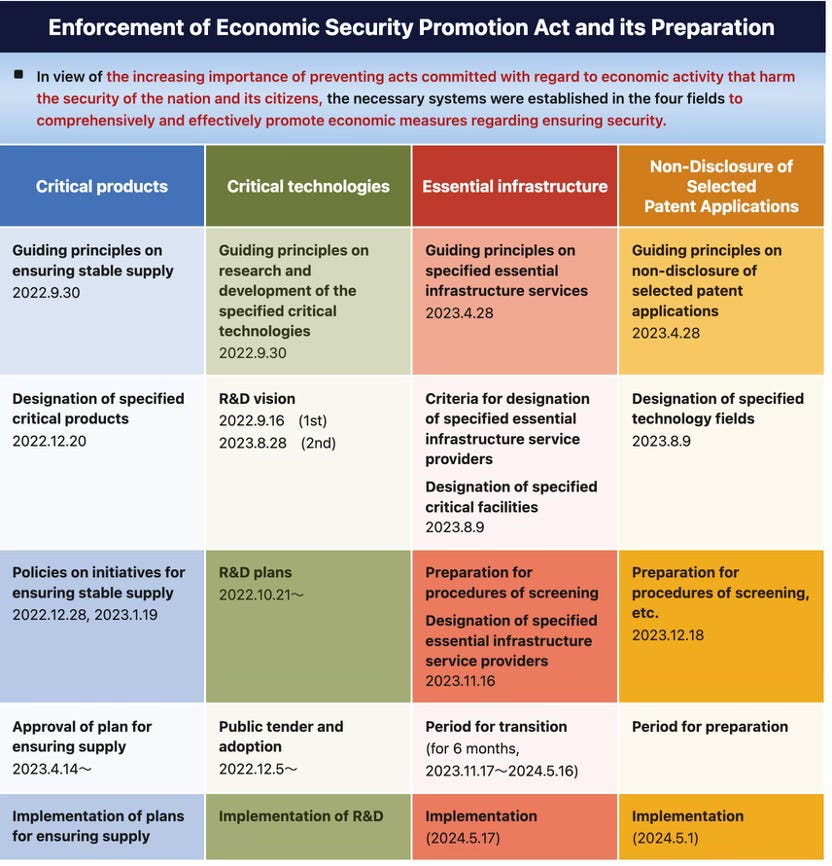
In May 2022, the Japanese government passed its Economic Security Promotion Act (Act on the Promotion of Ensuring National Security Through Integrated Implementation of Economic Measures; ESPA hereafter), which laid out four priority tracks for legislative solutions:
the “system for ensuring stable supply of critical products,”
the “system for ensuring stable provision of essential infrastructure services,”
the “system for enhancing development of specified critical technologies,” and
the “system for non-disclosure of selected patent applications.
These tracks and their[ implementation dates are summarized in the table below. This was provided by Japan’s National Security Secretariat in January 2025.
I’ll close this post with a few comments:
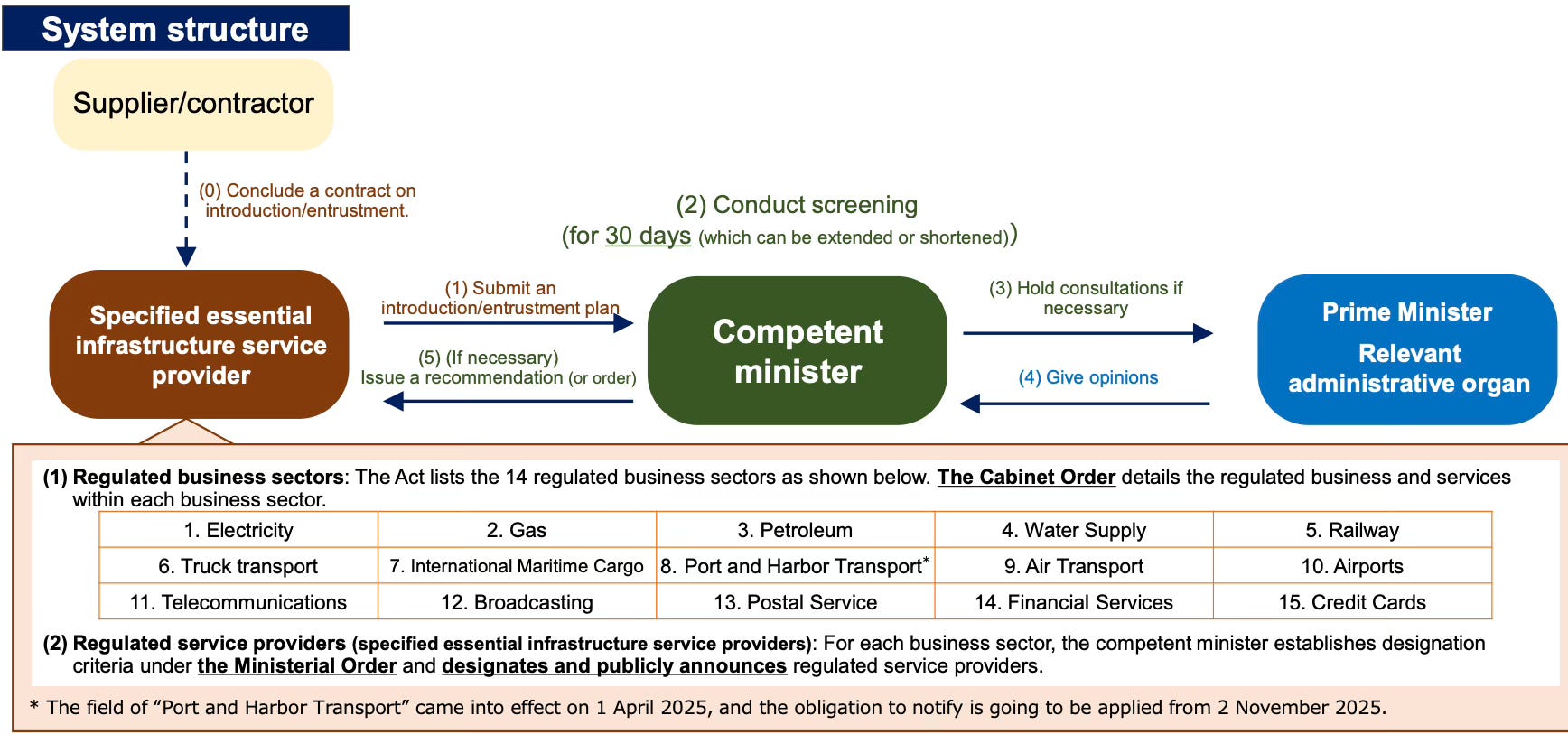
the juxtaposition in emphasis with our CHIPS Act in the US is quite striking - ESPA extends well beyond semiconductor production, into Item 2 above, e.g. provision of 15 categories of key infrastructure services, including water, gas, petroleum and railway, among others. Full diagram of relevant infrastructure categories, current as of July 2026, is listed below
in the US, we don’t have an economic security cabinet post, per se; but the Commerce Secretary and White House are, in essence, filling that role
As of May 2026, revision of the Economic Security Promotion Act to extend it to key chemical products was under discussion, given disruptions to access to key materials (e.g. naphtha) traversing the Straits of Hormuz, and a revision was passed in June
Packages to TSMC, Rapidus, Kioxia, Sandisk and Micron have captured most of the English-language headlines about Japan’s semiconductor reinvestment, and deservedly so. That said, roughly $7 billion in smaller packages has gone into traditional semiconductors, manufacturing equipment (semicap), components and materials, and raw materials (e.g. neon, helium). I’ll get into that in my next excerpt.
Since this post is in part about Kumamoto, I’ll close with an album of pictures from my visit there in May 2025. Many thanks to my gracious hosts at Kumamoto University.


Onward and upward!
Jon